

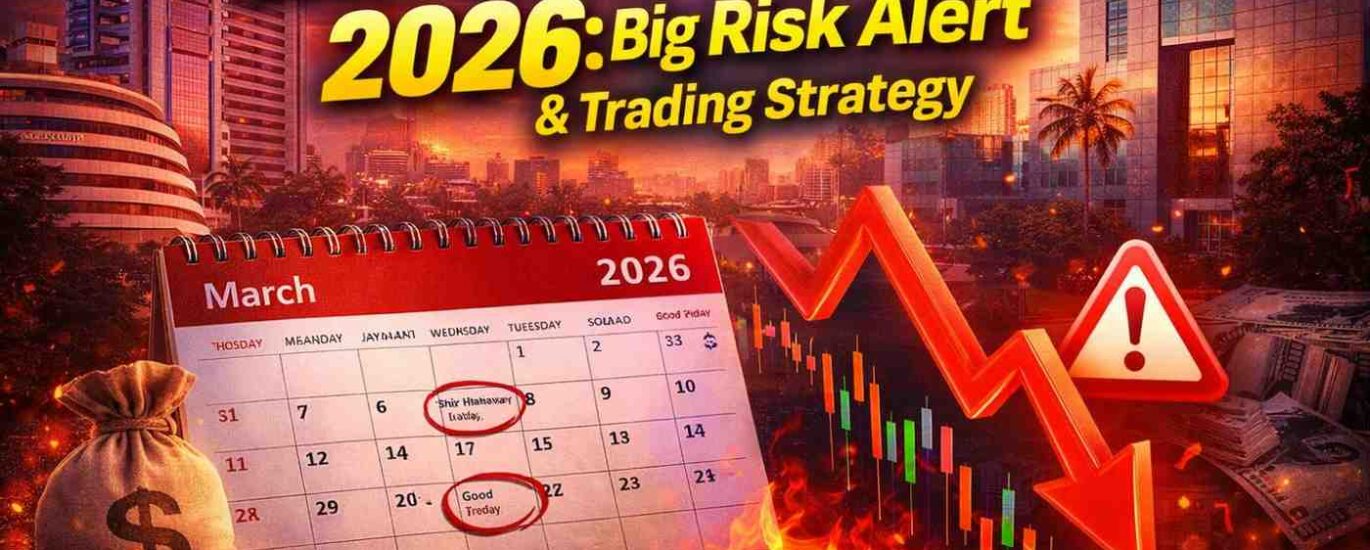
Stock Market Holidays 2026: If you’ve looked at the market calendar for this week—the final stretch of March leading into April 2026—you’ve likely noticed a significant disruption. With Shri Mahavir Jayanti (Tuesday, March 31) and Good Friday (April 3) both falling within the same five-day window, the Indian stock exchanges (NSE and BSE) are effectively cutting our trading time by 40%.
For the casual observer, it’s just a shorter work week.
But for those of us who have skin in the game, having two holidays in one week poses a unique set of risks. Having gone through several ‘truncated weeks’ in my investment career, I can assure you that these truncated weeks often lead to unpredictable markets and ‘liquidity traps’ that even the most experienced investors might not be prepared for.
The Hidden Risks of a Truncated Trading Week
Having the markets shut down for two separate days in one week is not ideal; the information ‘flow’ never stops, but our response to it does not.
This creates a few specific problems that I always watch out for:
1. The “Gap” Risk
Global markets in the US, Europe, and Asia don’t pause just because Dalal Street is closed. If a major geopolitical event or a shift in US inflation data occurs on Tuesday or Friday, we can’t hedge or exit our positions. When the market finally opens the following day, prices often “gap up” or “gap down” significantly, bypassing your stop-loss orders entirely.
2. The Year-End Deadline Clash
This week, in particular, is a tricky one because March 31 marks the end of the financial year (FY 2025-26). Usually, this is a day for tax-loss harvesting and portfolio rebalancing. Because the market is closed on the very last day of the fiscal year, any tax-saving trades or settlement-related moves must be completed by Monday, March 30.
3. Thin Liquidity and High Volatility
With two holidays, many institutional players and high-net-worth individuals (HNIs) simply take the whole week off. This means that lower volumes would mean that a relatively lower sell order can cause a rather large price swing in a particular stock.Your “Short Week”
Read This Also: IVF with Irregular Periods: Can You Get Pregnant? 90% Don’t Know This!
Survival Checklist
To avoid any nasty surprises, I would recommend the following checklist before the onset of the first holiday:
Clear Intraday Positions: Do not carry any heavy positions going into a holiday. The overnight risk is magnified.
Verify Settlement Dates: Remember that T+1 settlement is pushed back. If you are selling shares on Monday, the funds may not be available for withdrawal at the expected time.
Review Margin Requirements: If there are derivative positions (F&O), there must be a “buffer” margin to account for the potential gap opening.
Finalize Tax Trades: Ensure all “Profit/Loss Booking” is executed on Monday, as Tuesday is a hard stop for the financial year.
Check MCX Timings: Unlike the NSE/BSE, the commodity market (MCX) is likely to open in the evening on Mahavir Jayanti. Double-check your broker’s schedule if you trade Gold or Oil.
Trading Schedule: Week of March 30 – April 3, 2026
| Date | Day | Market Status | Reason |
| March 30 | Monday | Open | Normal Trading |
| March 31 | Tuesday | Closed | Shri Mahavir Jayanti |
| April 1 | Wednesday | Open | First Day of New FY |
| April 2 | Thursday | Open | Weekly F&O Expiry |
| April 3 | Friday | Closed | Good Friday |
Read This Also: Vivid Electromech IPO 2026 pply or Skip? Full Details!
Real-Life Mistake: The “Expiry” Trap
A common mistake I see during holiday weeks involves the weekly Options Expiry (usually Thursday). When Friday is a holiday, the volatility on Thursday often ramps up because it’s the last day to square off weekly contracts.
The Fix: If you aren’t an experienced scalper, consider closing your weekly F&O positions by Wednesday afternoon. Don’t wait for the “Thursday madness,” as the shortened week usually makes the gamma moves more violent than usual.
Summary and Takeaway
A week with two holidays is a time for capital preservation, not aggressive speculation. The combination of the financial year-end and the lack of liquidity creates a “perfect storm” for volatility. My best advice? Use the extra days off to review your long-term strategy rather than trying to outsmart a market that is only half-open.
FAQs
1. What are the Stock Market Holidays 2026?
The Stock Market Holidays 2026 comprise the days when the NSE and BSE markets remain shut due to festivals. The Stock Market Holidays 2026 impact the overall trading activities in the markets.
2. Why are holiday weeks risky for traders?
During the Stock Market Holidays 2026, the global markets remain open. This might cause gap-ups or gap-downs in the markets when they open in India.
3. Should I trade during holiday weeks?
During the Stock Market Holidays 2026, it is better to avoid taking any risks and hold fewer positions because of the uncertainties in the markets.
4. How does the Year-End impact the markets?
The Stock Market Holidays 2026 occur around the financial year-end. This might cause tax adjustments in the markets.
5. How to Stay Safe during the Holiday Trading Weeks?
One needs to be disciplined during the Stock Market Holidays 2026 and hold enough margins in the accounts.